Game Theory: The Birth of Interactive Theatre
Ambavi Creators' latest production transformed the 2026 theatre season into an entirely new kind of audience experience. Bringing together immersive storytelling, audience participation, artificial intelligence, and projection mapping, Game Theory became far more than a stage performance. It was a multidisciplinary experiment that allowed us to rethink what collaboration with a theatre could become.
When City Theatre approached us about creating a production together, we didn't hesitate. Reinventing the familiar has always been at the heart of what we do. We look for unexpected perspectives and use them to create experiences that feel genuinely new.
Immersive Storytelling in Service of Theatre
The original concept came from director
Koko Roinishvili
, who had already developed the central narrative of the play. Our ambition, however, was to transform that story into an immersive experience - one where the audience would no longer remain passive observers, but become active participants in the unfolding drama.
During the early creative discussions, we asked ourselves a simple question:
what do all traditional theatre performances have in common?
The answer seemed obvious. Before every performance, audiences are asked to silence or switch off their phones. They may occasionally interact with the actors, but they never influence the story itself. The dramatic structure remains fixed, unfolding exactly as the director intended.
So we decided to reverse that convention.
Instead of asking people to put their phones away, we asked them to keep them in their hands. We developed a dedicated mobile application that allowed every audience member to influence the performance in real time, turning the smartphone from a distraction into an essential theatrical tool.
What Is Game Theory About?
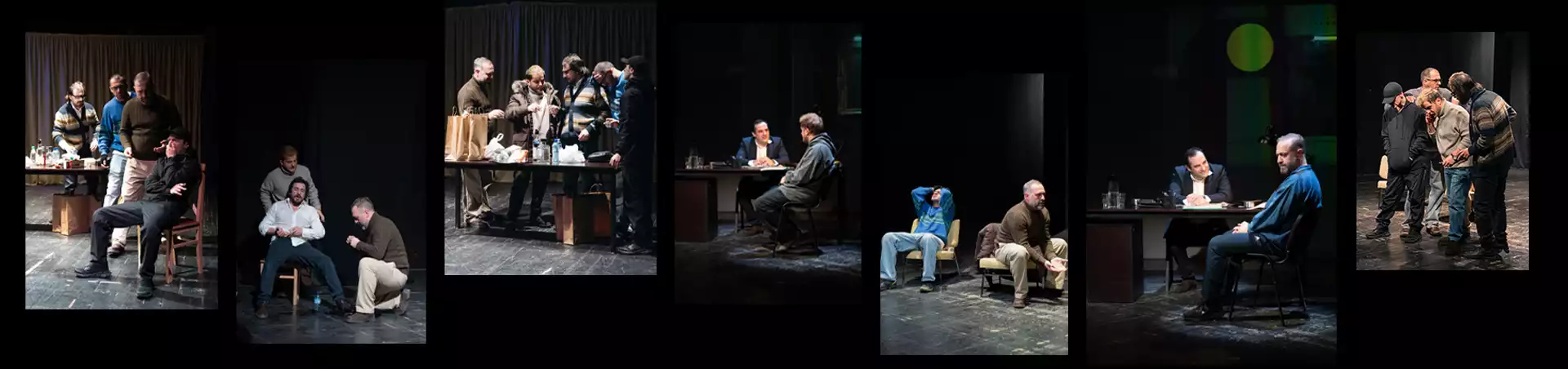
Game Theory follows five lifelong friends who share a secluded country house known only to them. One winter day they arrive to discover the body of Nini, a young woman each of them knew well. She has been murdered. Because no one outside their circle even knows the house exists, one conclusion is unavoidable: the killer must be one of the five friends. Against this backdrop, years of buried resentment, hidden conflicts and carefully guarded secrets begin to surface.
The first act
establishes the mystery and introduces the characters.
The second act
shifts entirely to the investigation, where an inspector interrogates each of the five suspects - and where the audience begins to shape how that investigation unfolds.
What Does Interactive Theatre Mean?
For us, creating a theatre production was never the ultimate goal. Game Theory became an exploration of a much bigger question:
can an audience become an active participant in a story without breaking its dramatic structure?
That question lies at the heart of every immersive experience we create.
Pursuing an idea that has no established blueprint is always risky. It means solving problems no one has solved before. From the very beginning, we knew that a conventional script would not be enough. The story had to remain coherent while allowing multiple paths to emerge, each leading to a different outcome.
To achieve this, we borrowed a
classic literary technique
: changing the sequence in which information is revealed fundamentally changes the audience's perception of the story. Using our
custom-built mobile application
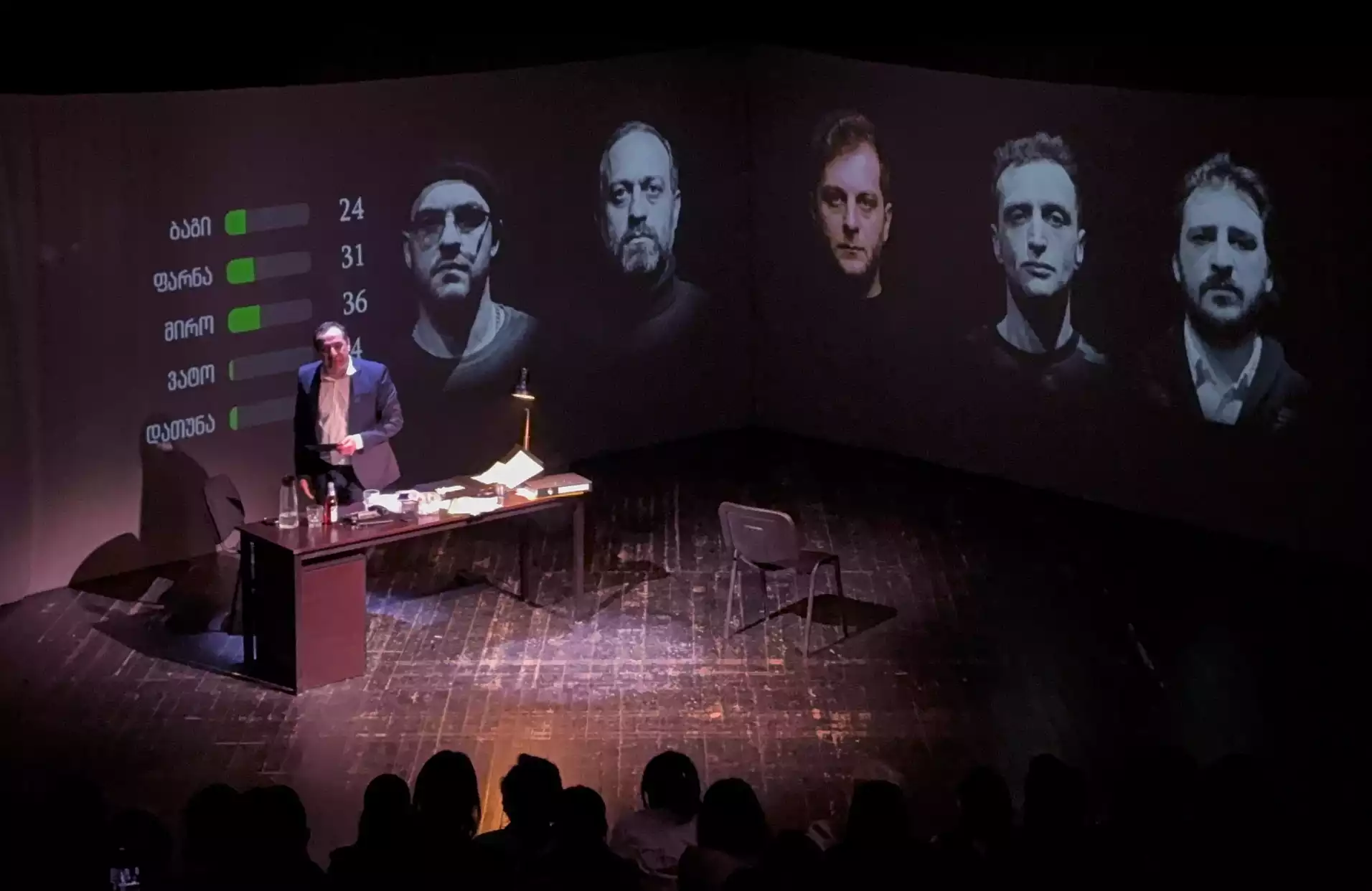
, audience members decide the order in which the five suspects are interrogated. A single choice immediately alters the rhythm of the investigation, the flow of information, and ultimately the way every spectator interprets the mystery.
How Audience Participation Changes Theatre
Giving the audience control over the order of interrogations was only the beginning. If we wanted people to feel like participants rather than observers, they needed the ability to influence the investigation itself. Throughout the second act, audience members can submit questions to the detective in real time using the mobile application. The detective then asks those questions directly to the suspects while the performance continues uninterrupted.
It was an exciting concept - but it immediately raised a series of complex challenges:
-
What if the audience submitted inappropriate or irrelevant questions?
-
What if only a small percentage of the questions actually contributed to the investigation?
Added to this were the technical challenges:
-
How could the detective review hundreds of incoming messages while remaining fully in character?
-
How could we preserve the rhythm of a live performance without breaking immersion?
-
Most importantly, how could we create genuine audience participation without turning the actors into improvisers disconnected from the narrative?
Our first solution was to equip the detective with a tablet connected to the application's moderation system. But that solved only one part of the problem. The larger challenge still remained: how could all of this happen seamlessly, without the audience ever noticing the technology behind it?
AI Behind the Performance
One of the biggest technical challenges was managing audience questions in real time. During a live performance, the detective - played by
Vaniko Tarkhnishvili
- had only seconds to react. Reading through dozens of incoming questions while staying in character simply wasn't possible.
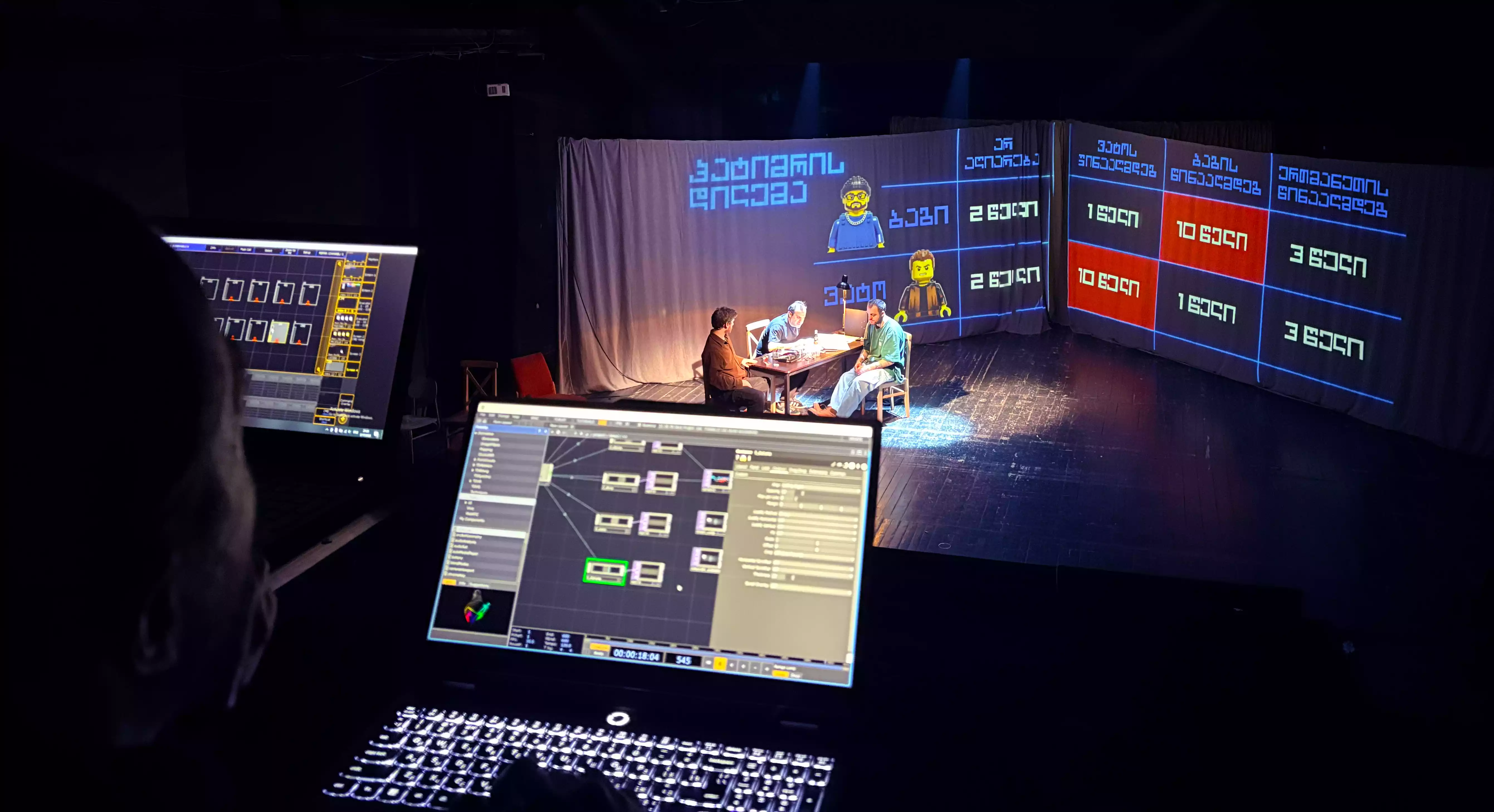
We needed another solution. We trained an AI system to moderate every submission as it arrived. It automatically filtered inappropriate content and ranked the remaining questions according to their relevance to the investigation. By the time the detective glanced at the tablet, the most meaningful questions were already waiting at the top of the list. The technology disappeared into the background, allowing the interaction to feel natural. Instead of interrupting the performance, audience participation became an organic part of the story itself.
A Living Visual Language & Projection Mapping
At Ambavi Creators, visual storytelling is never an afterthought. Every visual element should carry meaning, evolve alongside the narrative and respond to the emotional rhythm of the experience.
Working closely with
Barbara Aslamazi
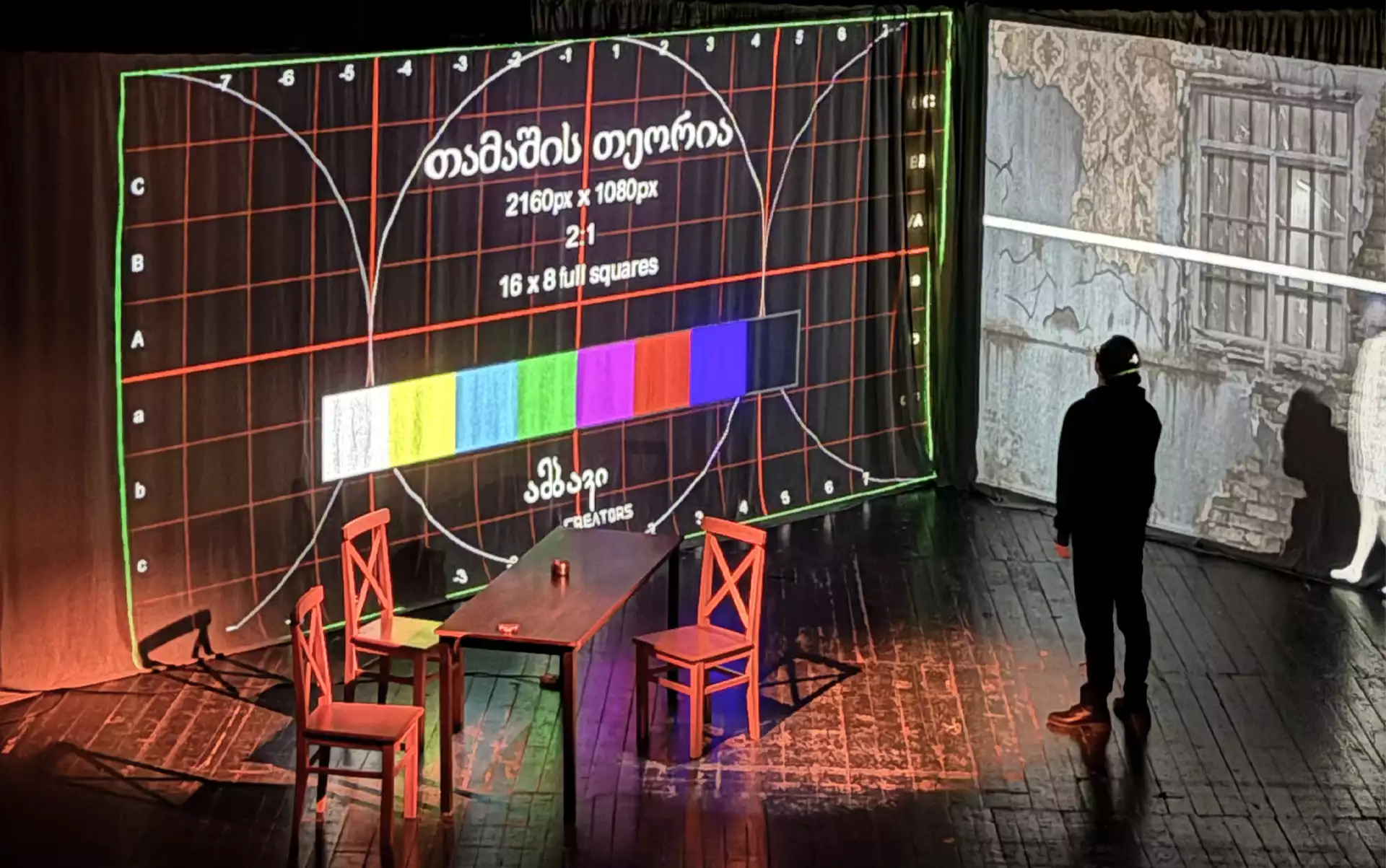
, the production designer at City Theatre, we developed a visual system that transformed the stage between the first and second acts. The first act relied on traditional theatrical scenography. The second became entirely different.
Physical scenery gradually gave way to projection mapping, creating an environment that could change alongside the investigation itself. Rather than projecting onto rigid architectural surfaces, we mapped moving stage curtains - an inherently unstable canvas that demanded exceptional technical precision. Because the transformation had to happen during the intermission, our technical teams had only a matter of minutes to recalibrate the entire projection system before the audience returned to the auditorium. Every transition had to be seamless. Every alignment had to be exact.
Once the performance resumed, the projections no longer functioned as background imagery. They became part of the narrative itself, shifting in response to each interrogation, reflecting the emotional state of individual characters, and reinforcing the central idea behind the production:
reality is never fixed. People are not static. Every new piece of information has the power to change how we perceive both the story - and one another.
Endless Versions of the Same Story
Once the audience became part of the investigation, another question emerged:
how do you preserve genuine choice without sacrificing narrative integrity?
Allowing the audience to influence the story inevitably creates countless possible paths. But unlimited freedom without structure quickly turns into chaos. We wanted to achieve two seemingly contradictory goals:
-
Every audience should feel that their decisions genuinely matter;
-
Every performance needed to exist within a coherent dramatic reality.
Our solution was deceptively simple. Each performance contains an objective truth: one of the five characters is, in fact, the murderer. The audience, however, doesn't know who that person is.
Throughout the investigation, spectators observe, question, analyse and ultimately vote on who they believe committed the crime. Their verdict becomes the official conclusion of that particular performance. Only afterwards does the detective reveal who the murderer actually was in that version of the story - and why.
This approach transforms the audience's final vote into something far more meaningful than a guessing game. It becomes a reflection on judgment itself. How confident can we ever be in our conclusions? How easily can incomplete information lead us to the wrong verdict? And how much responsibility comes with deciding another person's fate?
Acting Cast
Executing these complex tasks required an exceptionally professional and highly experienced acting ensemble. They were the crucial element responsible for breathing life into the ideas and turning a fully interactive experience for the audience into reality.
Unlike traditional theater - where actors follow a strict script and dramatic framework - here, the cast steps onto the stage in Act II without knowing what direction the play will take, what questions the audience might ask, or how events will unfold. Taking on this challenging task were
Vaniko Tarkhnishvili, Nodar Dzotsenidze, Irakli Chkhikvadze, Giorgi Makharadze, Shako Mirianashvili, Beka Khachidze and Sandro Qasrashvili.
A New Model for Brand Integration
This innovative format paved the way for an entirely new theater sponsorship model. While companies previously functioned merely as general sponsors, we launched a full-scale campaign using influencer marketing to seamlessly integrate brands directly into the play's narrative. This was no longer just a quick sponsor shout-out before the curtain went up; the products became functional storytelling devices within the show.
During its first season, Game Theory was supported by three partners:
-
Dressup
, which designed and supplied the costumes for the characters;
-
Zoomer
, which provided the high-performance computers and tablets that powered the interactive system;
-
Somersby Cider
, whose product became part of both the story and the mobile application, where audience members could receive surprise rewards throughout the experience.
The Best-Selling Production of the Season
Game Theory became the undisputed hit of the Spring 2026 theatrical season. Following its premiere on March 26, tickets were consistently sold out weeks in advance throughout the entire run.
This overwhelming response proved that this successful experiment deserves to be carried forward into new productions. It has the potential to redefine modern theater and we are actively working on our next project. In the meantime, Game Theory has earned a permanent spot in City Theatre's core repertoire.
For us, Game Theory was more than just a theatrical experiment. It reminded us that when the audience becomes an active participant rather than just an observer, the entire experience reaches a whole new level. Stay tuned for the opening of the new season at
City Theatre
and don't miss the birth of our next interactive show!